
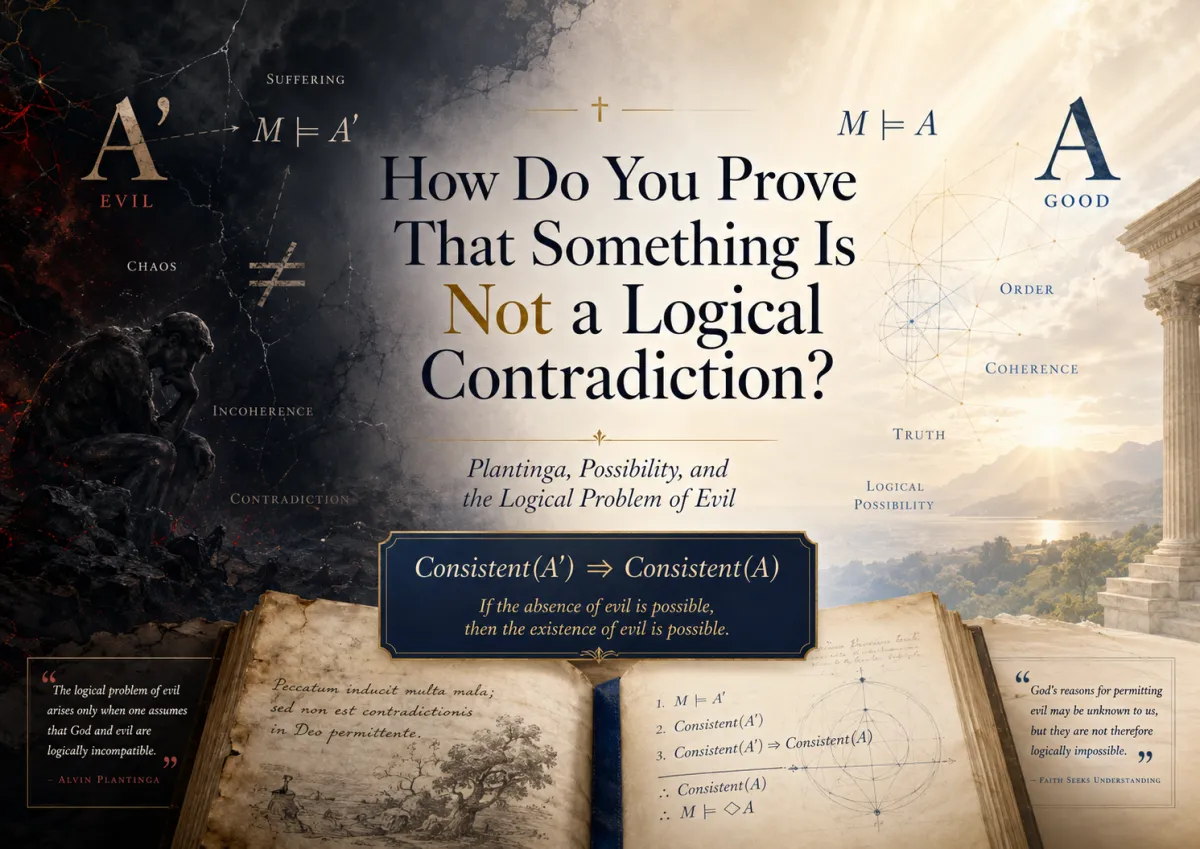
How Do You Prove That Something Is Not a Logical Contradiction?
It is relatively easy to prove that a set of propositions is logically contradictory. If we can derive both a proposition and its negation from the same set of premises, we have found a contradiction, and thus proven that the set of propositions is logically contradictory.
But how do we prove the opposite?
How can we demonstrate that a collection of beliefs which appears contradictory is, in fact, logically consistent? I am not prepared to suggest that the following process is the only way to prove logical consistency (it certainly isn’t), but there is a method of proving logical consistency that is surprisingly simple.
In this article, I will first break down the methodology for proving logical consistency, and then demonstrate how this, in combination with Plantinga’s Free Will Defense, proves there is no logical problem of evil, even if the Free Will Defense is not the actual explanation for evil.
Part 1: The Logical Argument
Let A represent some set of propositions: A={P1,P2,P3,…,Pn}
Suppose someone claims that A contains a logical contradiction. In other words, they claim that there is no possible situation in which every member of A can simultaneously be true. Now introduce an additional proposition, Q, and form a larger set: A′ = A ∪ {Q}
Suppose we can demonstrate that A′ is logically consistent. That is, there exists at least one possible model M in which every proposition contained in A′ is true: M⊨A′
But since A ⊆ A′ the same model necessarily satisfies every proposition contained in A: M⊨A
Therefore Consistent(A′) ⇒ Consistent(A)
Another way to see it is through the contrapositive: Inconsistent(A) ⇒ Inconsistent(A′)
Or, to say this simply: One way of showing that no contradiction exists between a set of premises, is to add another premise which, in some cases, can make it easier to see logical coherence. Then, demonstrate logical coherence in the larger set of premises. If you can show logical coherence in the larger set, you have necessarily shown logical coherence in the initial set (or proven there is no logical contradiction).
If A really contains a contradiction, adding another proposition cannot remove that contradiction. Once a contradiction exists inside the original set, it remains inside every larger set containing it. Therefore, if we can construct even one consistent extension of A, we have proven that A itself was never logically contradictory.
This of course, leads to the question of the additional premise or premises. What needs to be the case, in regards to these additions? Let us now turn to the somewhat counterintuitive reality of these additional premises.
The Added Premise(s) Need Not Be True
This may seem counterintuitive, but the additional premise or premises do not have to be true of the actual world. Suppose Q is false. That does not necessarily matter. We are not attempting to prove Q. We are attempting to prove Consistent(A). For that purpose, Q need not describe the actual world. It merely needs to describe a logically possible state of affairs that can coexist with A. In other words, in the set A’={P1,P2,P3,…,Pn,Q} our goal is not to establish that every proposition is actually true, but that they can all be true simultaneously. Thus the actual truth of Q is irrelevant to the consistency proof; what matters is its logical possibility.
If someone claims, “There is no possible world in which these propositions can all be true,” then we do not have to show them the actual world. We only have to show one possible world. A single counterexample defeats an impossibility claim. This is precisely what makes Alvin Plantinga's famous response to the logical problem of evil so powerful.
Part 2: Plantinga and the Logical Problem of Evil
The classical logical problem of evil alleges that the traditional attributes of God are logically incompatible with the existence of evil. We can simplify the relevant set as: A = {Go, Gk, Gg, E} where:
Go = God is omnipotent
Gk = God is omniscient
Gg = God is perfectly good
E= Evil exists
The logical problem of evil claims: Inconsistent(A) That is an extraordinarily strong claim. It does not merely say, “Evil makes God's existence less probable.” Nor does it say, “I cannot understand why God would permit evil.” It says something much stronger, “There is no logically possible world in which an omnipotent, omniscient, perfectly good God and evil coexist.”
Plantinga's Free Will Defense responds by constructing an expanded set of propositions. Call the relevant additional propositions F: A′ = A ∪ {F}
Very roughly, F describes a possible state of affairs in which God has morally sufficient reasons for creating significantly free creatures despite the possibility of those creatures committing evil. Plantinga's actual treatment is considerably more sophisticated than this summary, involving possible worlds, significant freedom, and what he calls transworld depravity. But for our present purpose, something important should immediately become apparent.
Plantinga does not have to prove F is true. He only needs to show F is possible. If Consistent(A ∪ {F}) then necessarily Consistent(A), and the original allegation of logical incompatibility has failed.
This is exactly how contemporary philosophical treatments describe the burden of Plantinga's defense. The Internet Encyclopedia of Philosophy notes that, because the logical problem asserts that God and evil cannot coexist, Plantinga needs only a logically possible situation in which they do. His explanation need not be actual, realistic, or even supported by evidence for it to defeat that particular claim.
That distinction is also why Plantinga offers a defense, not necessarily a theodicy. A theodicy attempts to tell us why God actually permits evil. A defense has a much narrower burden: Show that God could have a morally sufficient reason. And that is enough for the logical question.
You Can Reject Plantinga's Explanation, but His Result will still stand
This produces an important—and often misunderstood—consequence. Plantinga does not need the Free Will Defense to describe the actual world in order for his argument to succeed. Suppose, for the sake of argument, that libertarian free will is false. Suppose God did not permit evil for the reasons Plantinga proposes, and suppose Plantinga’s account gets the actual explanation for evil completely wrong. None of that, by itself, restores the logical problem of evil.
Plantinga is not necessarily trying to prove that the Free Will Defense is the true explanation for evil. He is trying to show that the traditional attributes of God and the existence of evil are logically compatible. Using the notation from earlier, Plantinga does not need to prove that F is true. He needs only to show that the expanded set, A′ = A ∪ {F}, is logically consistent.
If A′ is logically consistent, then A must also be logically consistent, because A is contained within A′. Any possible world in which every proposition in A′ is true is necessarily also a possible world in which every proposition in A is true. Whether F actually describes our world is therefore irrelevant to that conclusion.
A person could consistently say, “I do not believe Plantinga’s Free Will Defense describes why God actually permits evil.” They could even deny that human beings actually possess the kind of libertarian freedom Plantinga describes. Yet, given that the state of affairs Plantinga describes is logically possible, they must grant that God and evil are logically compatible.
That is enough to defeat the classical logical problem of evil. This is what makes Plantinga’s accomplishment stronger than merely proposing a plausible explanation for evil. He did not need to discover God’s actual reason for permitting evil; he needed only to demonstrate that there is no logical contradiction between the existence of an omnipotent, omniscient, perfectly good God and the existence of evil.
And that is exactly what the Free Will Defense accomplishes. Plantinga may be wrong about why evil exists. The Free Will Defense may be false as a description of reality. But since the state of affairs Plantinga describes is logically possible, it follows that the claim that God and evil are logically incompatible is false.
